Session # 11
THE ALGEBRAIC NOTATION
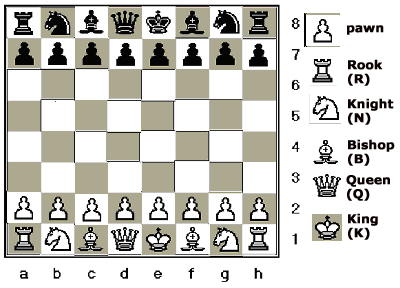
We are now going to learn how to record our game. The algebraic notation
is the way that is used to record the game. Every good chess board should
have letters in the bottom and numbers on the sides, with this we can
now give each individual square a letter and number to represent it,
like e4. Now If we can do the same with the pieces, we will be able
to say which piece moves on which square. The pawn doesn't have a letter
to represent it, the king, will be represented by: K , the Queen = Q,
the Bishop = B, the Knight = N, the Rook = R. We can now identify the
pieces and the squares with letter, numbers and symbols, we now need
symbol to represent if it's a movement, a capture, a check, check mate,
etc…
TABLE OF THE DIFFERENT SYMBOLS
|
Symbol
|
definition
|
example
|
|
-
|
moves to
|
Qb6-d4
|
|
+
|
Check
|
Qb6-d4+
|
|
x
|
captures
|
Qb6xd4
|
|
mate
|
check mate
|
Qb6-d4 mate
|
|
:
|
promoted pawn
|
e8 : Q
|
|
?
|
Bad move
|
Qb6-d4 ?
|
|
!
|
Good move
|
Qb6-d4 !
|
|
*0-0
|
Small castle
|
0-0
|
|
*0-0-0
|
Big castle
|
0-0-0
|
|
*++
|
double check
|
Qb6-d4++
|
|
½ ½
|
Draw
|
Qb6xd4 ½ ½
|
|
0-1
|
White loses or resings
|
Qb6-d4 0-1
|
|
1-0
|
Black loses or resisngs
|
Qb6-d4 1-0
|
*These symbols are not important for now, but will be by the end of
the course.
Here is an example of how we prepare a sheet and how we
write the game.
White: Joe
Black: Mark
Date: 12/09/2010
|
White
1. e2-e4
2. N-f3
3.
4.
5.
6.
7.
8.
9.
10.
(...)
|
|
At the end of every session, we recommend pracicing
and / or doing some chess puzzles. This site has chess puzzles and also
a chess forum so you can chat with other players. http://www.chessnerds.com

Choose your session:
1 - 2
- 3 - 4 - 5
- 6 - 7 - 8
- 9 - 10 - 11
- 12 - 13 - 14
- 15 - 16 - 17
- 18 - 19 - 20
- 21 - 22 - 23
- 24 - 25 - 26
- 27 - 28